316 stainless steel has earned its place in marine construction. It handles saltwater exposure reasonably well, it’s widely available, and it’s familiar to fabricators. But in more aggressive environments—offshore platforms, submerged fasteners, splash zones—its limitations become clear.
Pitting. Crevice corrosion. Stress corrosion cracking that shows up earlier than expected.
These aren’t anomalies, they’re predictable failure modes. And they’re expensive.
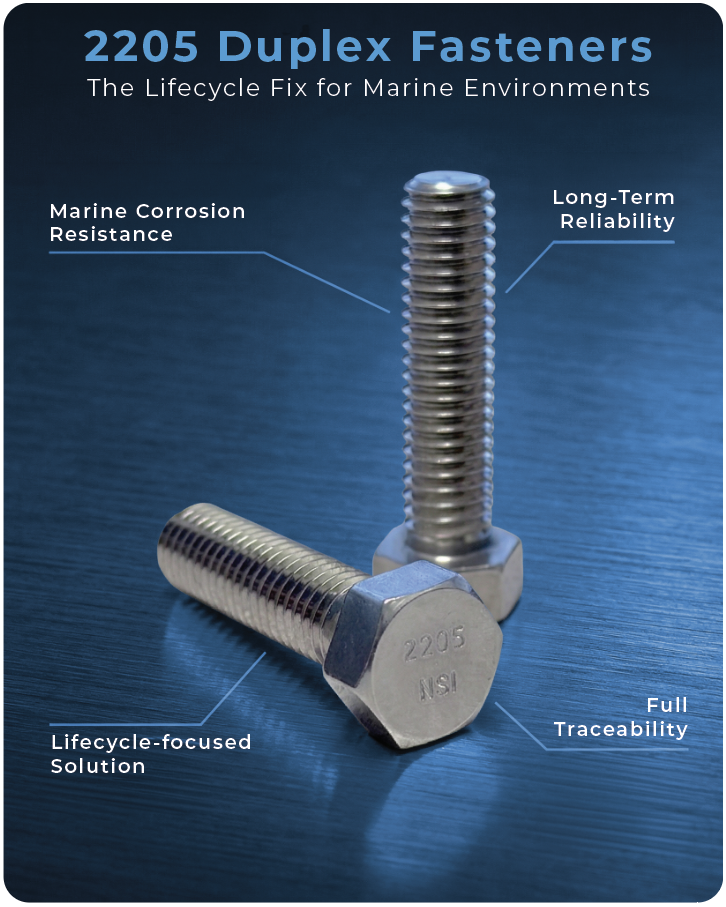
When marine applications demand longer service life and reduced maintenance, 2205 duplex stainless steel is increasingly the better solution.
Marine environments are among the most corrosive conditions materials will face. Salt spray, standing water, oxygen-depleted crevices, and cyclic loading all accelerate degradation.
316 has long been the default marine-grade stainless—and for many moderate applications, it still performs well. But as chloride exposure increases, its performance window narrows. That’s where duplex alloys like 2205 begin to stand apart.
316 remains a strong, reliable material in many marine applications.
For applications with controlled exposure and predictable maintenance, 316 is still a valid and effective option.
In harsher marine conditions, three primary failure modes drive reduced service life:
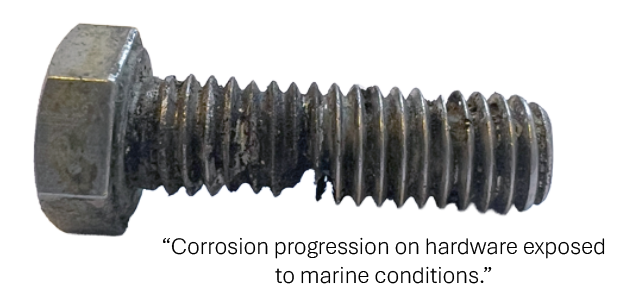
Chloride ions can locally break down the passive layer, leading to deep, localized attack. In crevices—such as under fasteners or inside threaded connections—low oxygen conditions accelerate this process, often out of sight until damage is advanced.
When tensile stress and chlorides combine, cracks can initiate and propagate without visible warning. This is particularly concerning in high-stress or elevated temperature environments.
These mechanisms are not rare—they are inherent risks in high-chloride marine exposure.
2205 duplex stainless steel combines austenitic and ferritic structures, resulting in a material specifically suited for aggressive environments.
Superior Corrosion Resistance
With higher chromium (~22%) and molybdenum (~3%) content, 2205 offers significantly improved resistance to pitting and crevice corrosion. Its duplex structure also provides strong resistance to chloride-induced stress corrosion cracking.
Higher Strength
2205 delivers roughly twice the yield strength of 316, enabling:
Lifecycle Performance
In applications where maintenance is difficult or costly—submerged hardware, offshore structures, critical fasteners—2205’s durability translates directly into longer service intervals and reduced total cost of ownership.
Across multiple marine applications, the shift from 316 to 2205 has produced consistent results:
These are not isolated cases; they reflect a broader trend where duplex alloys outperform in high-exposure environments.
316 vs. 2205: The Practical Difference
| Factor | 316 Stainless Steel | 2205 Duplex Stainless Steel |
| Corrosion Resistance | Good | Significantly higher |
| Pitting / Crevice Resistance | Moderate | High |
| SCC Resistance | Limited | Strong |
| Yield Strength | ~205 MPa | ~450 MPa |
| Upfront Cost | Lower | Higher |
| Lifecycle Cost | Higher in harsh environments | Lower in harsh environments |
The trade-off is straightforward:
316 minimizes upfront cost. 2205 minimizes long-term risk.
2205 is not necessary for every application. But it becomes the clear choice when:
In milder environments, 316 may still be entirely adequate. The key is aligning material selection with actual service conditions, not assumptions.
Before switching to 2205, a few practical factors should be evaluated:
316 stainless steel remains a dependable material—but it has limits in aggressive marine environments.
2205 duplex isn’t just an upgrade—it’s a shift toward lifecycle-driven material selection.
When corrosion, strength, and long-term reliability matter, the question isn’t whether 2205 performs better.
It’s whether the application can afford not to use it.