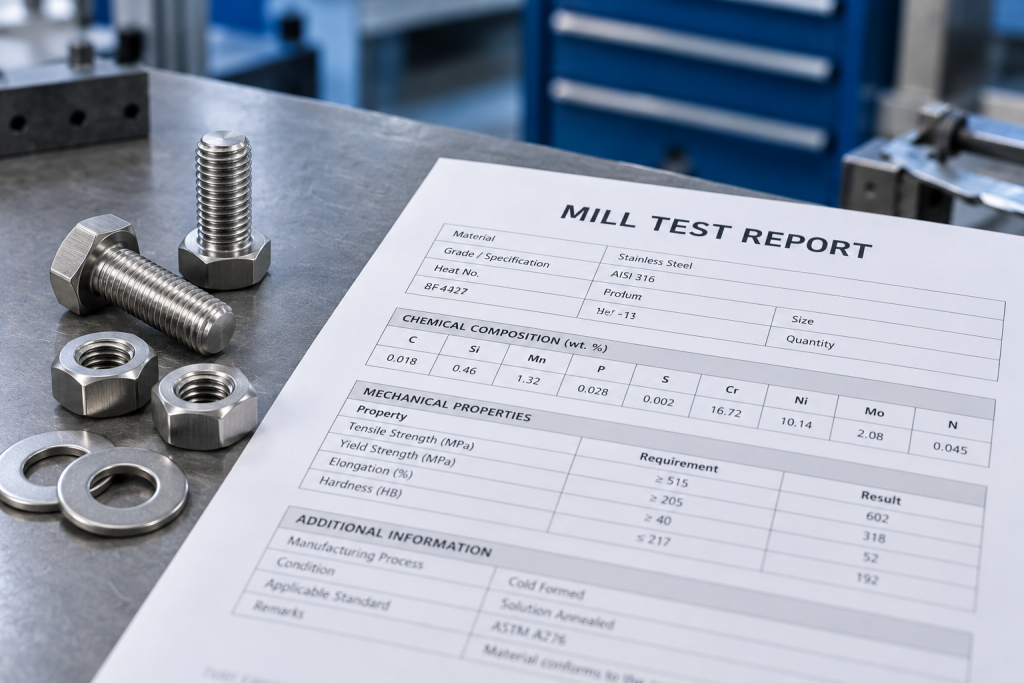
When ordering specialty fasteners or corrosion-resistant alloy materials, price and availability matter, but documentation matters too. A mill test report (MTR) helps buyers verify the reported raw material. For finished fasteners, additional manufacturing and inspection records may be needed to verify the supplied lot.
Buyers, engineers, and quality teams should check what each document actually covers and whether its identifiers match the material and fasteners received.
An original mill test report is issued for material produced by the mill. It typically records the material specification, heat number, chemical analysis, and applicable test results. It documents the reported material, but does not by itself establish the properties or identity of a finished fastener.
Finished fasteners may also require a manufacturer’s test report, declaration or certificate of conformance, or other inspection records covering manufacturing, heat treatment, mechanical testing, coating, and final lot identification, as specified in the order. ISO 16228 describes types of inspection documents for finished fasteners and uses “test report” for fastener inspection documents.
When the required identification and records have been maintained throughout manufacturing, the documentation can provide traceability from the finished fastener to its manufacturing lot and original material heat. An MTR alone does not prove that the supplied fastener came from the reported heat; the heat or lot identification on the product, packaging, and associated records must also match.
Fasteners can look identical while being made from very different materials. The wrong alloy, grade, or heat treatment can affect strength, corrosion resistance, service life, and overall safety.
An MTR helps verify that the reported material or fastener lot conforms to specified requirements. Determining whether the fastener is appropriate for the intended application remains the responsibility of the purchaser, engineer, or other responsible party. Documentation is often required in oil and gas, chemical processing, power generation, marine, water treatment, and aerospace projects.
Documentation is also important when a customer must meet internal quality procedures, customer specifications, or industry standards. Having the correct reports available upfront can prevent delays during receiving inspection or project approval.
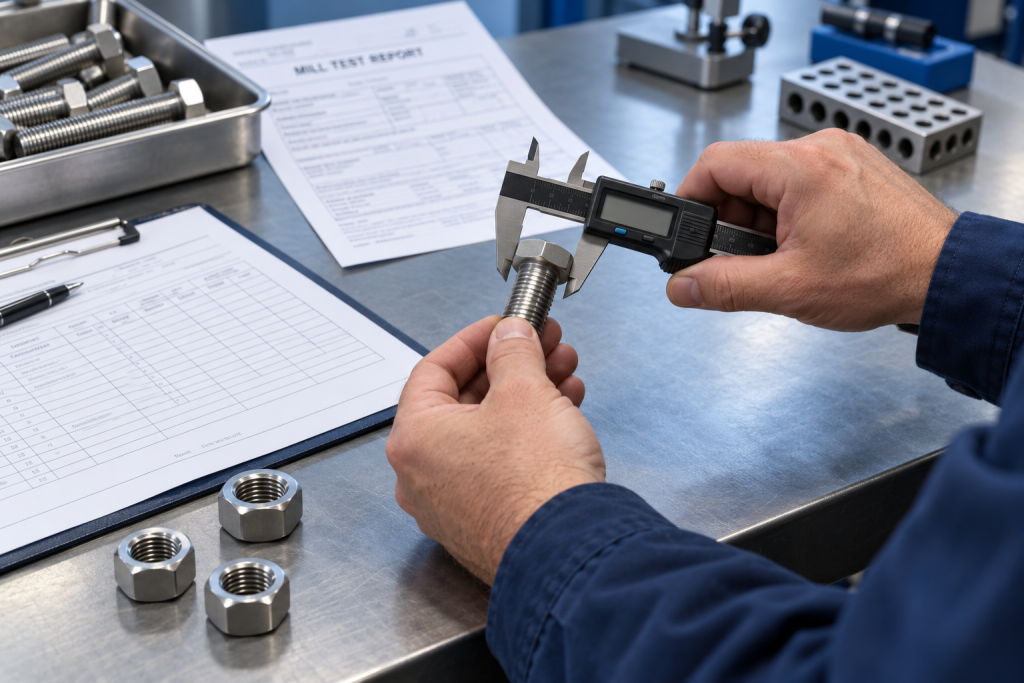
Before accepting fasteners, compare the MTR and any required finished-fastener records with the purchase order and the supplied product. Key areas to review include:
Material grade and specification
Confirm the full designation ordered. Examples include INCONEL® alloy 625 (typically UNS N06625), MONEL® alloy K-500 (typically UNS N05500), 2507 super duplex (commonly UNS S32750), and ASTM A193/A193M Grade B8M. Alloy names, UNS numbers, and finished-fastener grades describe different aspects of a product; they should not be treated as interchangeable.
Check the applicable material and fastener specifications and the required grade or class. For ASTM A193/A193M Grade B8M, identify the class as well: Class 1 and Class 2 have different processing and mechanical requirements. Compare the entire designation on the order with the documents supplied.
Heat and manufacturing lot traceability
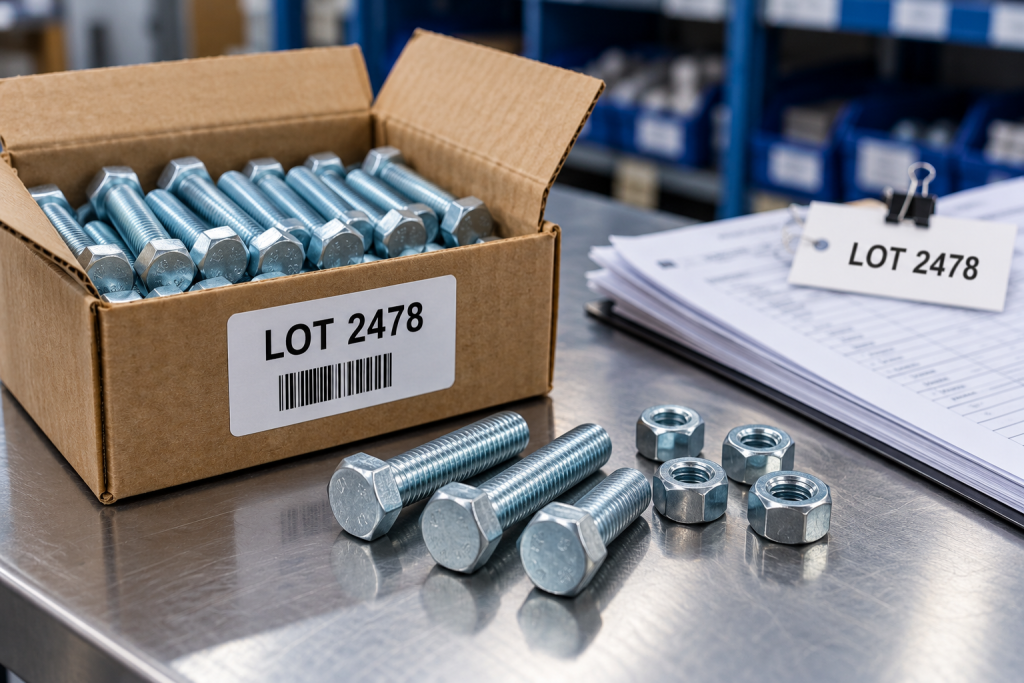
The heat number identifies material produced by the mill. Finished fasteners may also carry a manufacturing lot, heat-treatment lot, or test-lot identifier. Review the manufacturer identification and grade markings where required.
Check that the heat and lot identifiers on the reports match the product markings, packaging, tags, and manufacturing records, as applicable. If the link from the finished fastener to the original heat is unclear, request the missing records before acceptance.
Chemical composition
The chemical analysis typically reports the heat chemistry determined by the material producer. It is not necessarily a chemical test on each fastener. Product analysis or positive material identification (PMI) results may be reported separately when required.
Compare the reported values for elements such as nickel, chromium, molybdenum, and carbon with the limits in the applicable specification.
Mechanical properties
Mechanical results may include tensile strength, yield strength, elongation, hardness, or impact values, depending on the specification. Check whether the results apply to the raw material or to the finished-fastener test lot.
For finished fasteners, review the required grade, class, test methods, and any applicable heat-treatment records against the purchase order and specification. A raw-material MTR should not be read as proof that later fastener processing met those requirements.
Condition and heat treatment
Some alloys and fastener grades require a specified material condition or heat treatment. The mill report may describe the condition of the incoming material; a separate manufacturing record may be needed to document subsequent processing of the fasteners.
Confirm that the reported condition and any later heat treatment correspond to the grade, class, and test results required for the supplied lot.
Additional requirements may call for PMI to verify material identity; hardness, corrosion, or ultrasonic test results; coating records; or country-of-origin documentation. These are different records and should be checked against the specific requirements of the order.
For sour service, avoid relying on a general “NACE compliant” statement. Identify the precise standard and edition specified for the project and verify the relevant material condition, hardness or strength limits, heat treatment, product form, and service conditions against its acceptance criteria.
A report may look complete at first glance but still contain a problem. Common issues include:
If anything is unclear, it is best to ask questions before the material is put into production or installed in the field.
Mill test reports help establish what the mill produced. Finished-fastener documentation and consistent lot identification help establish what was manufactured and supplied. Review both against the requirements of the order.
At Nickel Systems, we help customers source specialty fasteners and corrosion-resistant alloy materials for demanding applications. Our team can help identify material options and coordinate the documentation specified for an order.
If you need specialty fasteners with material traceability and supporting documentation, contact Nickel Systems to discuss your specifications and inspection requirements.